Economic Sanctions: Financial Sector Impacts and Compliance
Explore how economic sanctions affect financial institutions, trade compliance, and global markets. Includes key regulators, risk controls, and real case studies.
 CRCGS
CRCGS
0
14
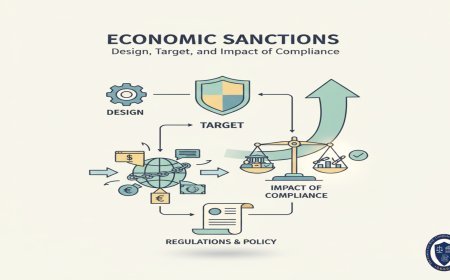
The most universal tool of world affairs and economic statecraft on the planet, economic sanctions are employed by states and multilateral organisations to advance national security interests, deter bad behavior, and influence geopolitics. Asset freezes, trade embargoes, travel bans, and financial sanctions are merely a flavor of the dark, Byzantine world of sanctions. Their application demands vigilant monitoring, especially on the part of global corporations and financial institutions as middlemen in the global economy. The article addresses the sustainability of economic sanctions, impact on financial systems and trade compliance, and lessons from large-scale global case studies.
Understanding the Framework of Sanctions
Sanctions can be imposed single-handedly by countries like the United States, United Kingdom, or Canada, or by multi-national entities like the United Nations Security Council or the European Union. Sanctions are either general in scope, i.e., against whole countries (the North Korea example), or focused sanctions against individuals, specific entities, sectors, or activities. Sanctions regimes are generally imposed on one, some, or all of the following: economic sanctions, trade and export bans, arms embargoes, travel bans, or denial of certain services such as insurance or consultancy.
Some of the principal regulators with the authority to issue and enforce sanctions are the U.S. Office of Foreign Assets Control (OFAC), the UK Office of Financial Sanctions Implementation (OFSI), the European External Action Service, and the UN Sanctions Committees. Each of them has its own sanctions list of persons and is governed by legislation specific to the jurisdiction.
Financial Institutions: Compliance Obligations and Risk
The regulatory duty of the financial institutions is not to make directly or indirectly prohibited transactions or business relationships with a designated entity or person. This duty of compliance begins with good customer due diligence (CDD). Banks and financial service providers are mandated to obtain customer identification, ownership structure information, and assess geographic and industry-related risk. For high-risk types, i.e., politically exposed persons (PEPs) or identification with sanctioned jurisdictions, further due diligence (EDD) is necessary.
Sanctions screening is another critical element. Institutions must screen payment transactions, trade finance documents, and customer files against United Nations, EU, OFAC, and local agency published sanctions lists. Screening software must be able to handle real-time data and flag suspicious or prohibited matches by applying fuzzy logic and smart filters to avoid false positives.
In addition to screening and CDD, transaction monitoring systems should also be in place. They detect potentially suspicious patterns of activity, i.e., transactions passing through high-risk territories, non-compliant beneficiary information, or attempts at concealment. Unintentional sanctions breaches may attract severe enforcement penalties, criminal liability, and reputational harm. Examples include the $8.9 billion BNP Paribas penalty for breaching U.S. sanctions against Sudan, Iran, and Cuba.
Trade Barriers and Corporate Compliance Requirements
Sanctions disrupt world trade by raising barriers to the import and export of goods, services, and technologies. Multinational companies must face intricate regimes of regulation in the process of export, obtain licenses where required, and avoid conducting business with embargoed parties. Dual-use items that are both civilian and military are most intensively scrutinised under the export control regime, e.g., the United States Bureau of Industry and Security (BIS) and the EU Regulation on Dual-Use Items.
Trade compliance also means customer, freight forwarder, and supplier screening to manage end-use and end-user needs. Companies must investigate not only where a product is going, but who is eventually going to consume it and why. Even humanitarian transactions will include extra paperwork and authorisation if transshipped through or delivered to high-risk countries.
Default or non-compliance in the business of trade, either through willful bad faith or negligence, can lead to severe sanctions such as fines, revocation of trading privilege, and criminal prosecution against responsible officers.
Case Study 1: Russia's Disconnection from SWIFT and Financial Fragmentation
After the invasion of Ukraine by Russia in 2022, Western nations imposed in unison a series of sanctions on the Russian economy. The most severe among them was the isolation of Russian key banks from the international messaging network of SWIFT. Sanctions were imposed on Russian government borrowing, the Russian Central Bank, and industries such as energy and defence (European Council, 2022).
SWIFT disconnection incentivised Russian banks to pursue alternative channels such as the SPFS (System for Transfer of Financial Messages) and Chinese CIPS (Cross-Border Interbank Payment System). Western banks also swiftly employed compliance measures, leveraging sanctions counterparties block, correspondent banking relationship freeze, and payments streams redirection. These actions indicate that the speed and scope of coercive sanctions within the financial system could exert influence on cross-border payment infrastructure and bank conduct (SWIFT, 2022).
Case Study 2: Iran Sanctions and Nuclear Compliance Complication
Iran has been the subject of international blanket sanctions on its nuclear sector for decades. Several of them were eased in the 2015 Joint Comprehensive Plan of Action temporarily. The 2018 American withdrawal, however, substituted secondary sanctions on Iranian banking, oil exports, shipping networks, and key sectors.
The effect was mass-scale financial de-risking, and international banks, under threat of U.S. enforcement, withdrew services even on humanitarian exception-approved transactions. Over-compliance was the new style and facilitated blocking legitimate trade, and made it challenging for European firms and banks to be active in Iran. The situation illustrates how extraterritorial jurisdiction and secondary sanctions can bring about global compliance behavior even where there is no direct legal restriction (Council on Foreign Relations, 2021).
Case Study 3: North Korea Across-the-Board Sanctions and Illegal Workarounds
North Korea is the most sanctioned country in the world. Cumulative Security Council Resolutions banning weapons sales, indulgences, gasoline exports, and financial transactions have been imposed by the United Nations. Unilateral American, European Union, and other regimes' sanctions have been piled on top of them so much so as to form a worldwide campaign of pressure.
While such sanctions are widespread, North Korea is also sophisticated in the manner it circumvents them by using front companies, offshore financial operations, and crypto cybercrime. There has been indiscriminate use of banned maritime shipping practices, including ship-to-ship transfer, flag-hopping, and bogus documentation to conceal sanctioned petroleum exports (Cholhok Publishing Co., 2024). The subject case refers to sanctions evasion typologies and the need for vigorous monitoring and intelligence-based compliance.
Best Practice and Sanctions Compliance Emerging Trends
Sanctions risk must be addressed by subject matter experts in compliance with a forward-looking, multi-layered approach. Some of the most critical best practices are:
- Properly established governance structures, i.e., board-level controls and sanctioned officers on the board.
- Sanctions compliance policies and procedures that cover the institution's full risk profile.
- Investment in highly developed technology infrastructure to achieve real-time screening, risk scoring, and automated alerting.
- Have multiple standard staff training sessions to promote sanctions awareness throughout departments.
- Maintain adequate and complete record keeping to facilitate audit, regulatory requests, and internal investigations.
- Future trends involve employing artificial intelligence-enhanced transaction monitoring, adverse media screening, and cross-jurisdictional data sharing to facilitate more effective detection and reporting. Regulators more frequently request firms to demonstrate the efficacy, not mere presence, of sanctions controls.
Conclusion
Sanctions are a central but complex element of global compliance. Their application is continually changing with geopolitics, national security, and breakthrough technology. Corporations and banks must remain nimble and reactive, adopting risk-based strategies and being receptive to new laws worldwide.
By linking regulation awareness with effective operation control, institutions can limit exposure, build regulatory confidence, and contribute to broader efforts at financial crime prevention and political destabilisation avoidance.