Economic Sanctions: Compliance Design, Targets, and Global Risk
Explore how economic sanctions are designed, enforced, and managed. Learn compliance risks, regulatory regimes, and best practices for global financial institutions.
 CRCGS
CRCGS
0
52
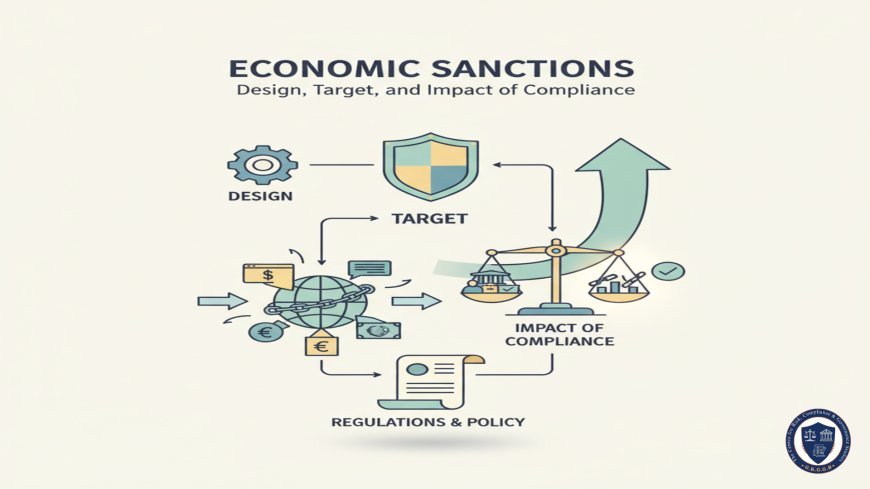
Understanding Economic Sanctions
Government and multilateral institutional non-military restrictions on the actions of individuals, groups, or states threatening international peace, security, or human rights are called economic sanctions. Economic sanctions can be applied in various forms, ranging from freezing assets and prohibiting trade to banning movement and financial services. Sanctions can be one-state, i.e., imposed by a single nation, or multilateral, i.e., imposed by bodies such as the European Union or the United Nations. Always remember that sanctions should be differentiated from embargoes: whereas embargoes are a complete prohibition of trade with or contact with an isolated nation, sanctions may be less obvious and more cunning.
Purpose and Strategic Objectives
Sanctions are foreign policy and regulatory deterrence tools. Their primary functions are to promote national security, prevent terrorism, prevent proliferation of weapons of mass destruction, and enforce international standards of the law. Sanctions exist to further human rights objectives by prosecuting masterminds of crimes against humanity, including genocide, torture, and systematic repression. For example, when Russia acted against Ukraine in 2022, America, the EU, and allies at one time levied mass sanctions against Russia's defence, energy, and banking sectors to short-circuit military capacity and diplomatic influence (European External Action Service, 2022). Sanctions are extremely diverse in scope and purpose.
Mass sanctions are wholesale refusals of trade, finance services, and diplomacy, e.g., US sanctions against North Korea. Targeted, or "smart," sanctions try to have a limited humanitarian effect by isolating groups or persons. They are applied using asset freezes and travel bans, such as on Belarusian election officials for human rights violations. Sectoral sanctions, e.g., the Russian defence and energy sectors, prohibit trade with sanctioned sectors. Secondary sanctions, primarily employed by the United States, penalise third parties for trading with sanctioned regimes, broadening the initial sanctioning authority's jurisdiction.
Sanctioning Regimes and Regulatory Agencies
Regulatory agencies play various functions in creating, implementing, and enforcing sanctioning regimes. In the United States, sanctions are authorised by the Office of Foreign Assets Control (OFAC) through powers such as the International Emergency Economic Powers Act (IEEPA). Specially Designated Nationals (SDN) and Sectoral Sanctions Identification (SSI) lists are OFAC sanctions enforcement tools. It is applied within the UK by the Office of Financial Sanctions Implementation (OFSI) under the UK Sanctions and Anti-Money Laundering Act 2018. Within the EU, the sanctions are coordinated within the EU's Common Foreign and Security Policy (CFSP) framework, and UN sanctions have been applied globally by the UN Security Council under Chapter VII of the UN Charter. Compliance programs must be attuned to differences in scope, enforcement, and extraterritoriality between these nations.
Practical Examples and Global Trends
Sanctions just keep rolling on and on by scope and sophistication. One of the broadest and most widely supported sanctions programs against Russia has been for Russia's abuse of Crimea and connected activities with Ukraine. The initiative of individual Western nations has been left in the hands of thousands of individuals and actors (Council on Foreign Relations, 2023). The Iran nuclear sanctions Joint Comprehensive Plan of Action (JCPOA) regime gives a clean-cut example of how sanctions can be used in the pursuit of the achievement of compliance with international obligations. While few were excluded under the JCPOA, the US sanction removal in 2018 introduced complexity into sanction compliance for cross-border transactions for multinational organisations.
Compliance Obligations and Best Practices
Sanctions compliance requires a persistent, risk-based initiative. Organisations should be equipped with robust customer and transaction screening against current sanction lists like OFAC's SDN List and the UK Sanctions List. It proposes the introduction of beneficial ownership regimes to impose the "50 Per Cent Rule" as well, and to sanction the owners and controllers of the sanctioned persons. Stronger due diligence screening will be required in high-risk jurisdictions or industries. Sanctions red flags of routing diversion or shell company use will need to be activated in existing transaction monitoring. In addition to technical controls, organisations will also need end-to-end documentation, audit trails, and escalation procedures. Training needs to be reinforced with live examples and practical advice on risk identification for circumvention. Regular contact with external consultants and advisers must also be ensured by organisations so that they may advise them on interpreting complex sanction regimes and risk exposure assessment.
Risks and Enforcement Issues
Sanctions non-compliance has serious legal, financial, and reputational consequences. Strenuous enforcement actions have already been imposed on corporations and banks, such as an $8.9 billion 2014 penalty on BNP Paribas for sanctions regulation violations in the United States. Sanctions evasion mechanisms become increasingly sophisticated, involving multi-level structures of ownership, use of intermediaries, and greater utilisation of cryptocurrency and decentralised finance (DeFi) platforms. Compliance programs will need to become savvy at detecting and tracking such new risks, which now depend on an application of machine learning and AI software to identify hidden links and hidden activity.
Emerging Issues and Regulatory Developments
Sanctions regulation is moving at warp speed. Sanction evasion of virtual assets is one of the emerging hotspots of concern. In addition, institutions such as OFAC and the FATF also issued advisory content in a bid to draw a line around the sanctions compliance business of Virtual Asset Service Providers (VASPs) (FATF, 2023). Sanctions with a sequential effect in a bid to combat environmental crime, corruption, and cybercrime are on. And the quarrel over sanctions is becoming increasingly cross-migrated into ESG regimes of compliance. Even the enforcement of sanctions is being supplemented with advanced technology. Banks are investing in artificial intelligence capabilities to perform entity resolution, network analysis, and risk scoring for the good. Regulators caution that technology should be a servant and never a replacement for good governance and human judgment. Companies can expect more regulatory expectations of sanctions governance, board transparency, and third-party risk management.
Conclusion
Sanctions are the fulcrum of the global compliance model. Unpredictable engagement between law, politics, and money regimes, sanctions need to be watched out for around the clock by the compliance fraternity. Enforcement is on the rise, geopolitics enter the fray, institutions need to embed internal controls, invest in training and technology, and remain on their toes as threats proliferate. Sanctions exposure control is a strategic rather than a regulatory imperative of the new world order of the global financial system.